The open-source AI video scene moves incredibly fast, but occasionally a release stands out because it improves the actual generation quality instead of simply adding another visual style. The OmniNFT RL LoRA for LTX 2.3 is one of those releases.
If you’re thinking about purchasing a new GPU, we’d greatly appreciate it if you used our Amazon Associate links. The price you pay will be exactly the same, but Amazon provides us with a small commission for each purchase. It’s a simple way to support our site and helps us keep creating useful content for you. Recommended GPUs: RTX 5090, RTX 5080, and RTX 5070. #ad
Rather than focusing only on aesthetics, OmniNFT uses reinforcement learning (RL) techniques to improve motion coherence, audio-video synchronization, lip sync accuracy, and overall temporal stability in generated videos. The result is a meaningful quality upgrade for creators using LTX 2.3 inside workflows such as ComfyUI.
What Is OmniNFT?
OmniNFT stands for:
Modality-wise Omni Diffusion Reinforcement for Joint Audio-Video Generation
The project introduces reinforcement learning into multimodal diffusion models that generate both video and audio together. Instead of relying only on traditional supervised fine-tuning, the model learns through reward optimization to produce outputs that better match desired behavior.
This is especially important for AI video generation because current models often struggle with:
- Lip sync drifting over time
- Sound effects not matching visual actions
- Temporal flickering
- Weak motion consistency
- Audio and visuals feeling disconnected
OmniNFT directly targets these problems during training.
Why Reinforcement Learning Helps AI Video
Traditional LoRA training mostly teaches a model to imitate patterns found in a dataset. Reinforcement learning works differently.
Instead of simply copying examples, RL evaluates generated results using reward signals and gradually pushes the model toward better outputs.
For AI video generation, this creates several major advantages.
Better Audio-Video Synchronization
The model learns whether motion and sound align correctly.
Examples include:
- Footsteps matching walking animations
- Mouth movement matching dialogue
- Explosions matching impact timing
- Dance movement syncing with music beats
Improved Motion Coherence
RL rewards temporal consistency, helping reduce:
- flickering
- unstable movement
- random frame corruption
- chaotic transitions
Stronger Cross-Modal Understanding
The model begins understanding relationships between sound and visuals instead of treating them as separate tasks.
This is one reason why OmniNFT generations often feel more cinematic and believable compared to baseline outputs.
Core Technologies Behind OmniNFT
The OmniNFT paper introduces several important ideas designed specifically for multimodal diffusion models.
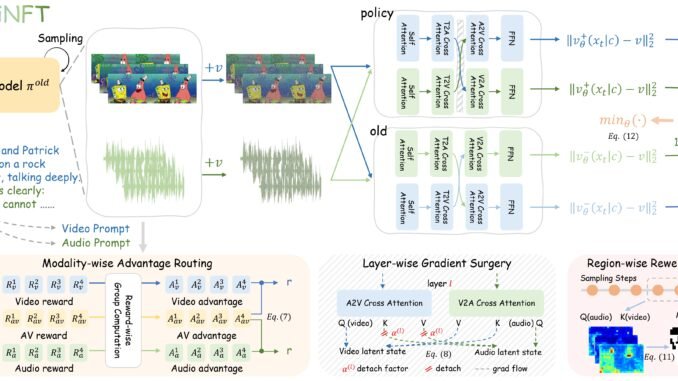
Modality-Wise Advantage Routing
Different rewards are routed to different sections of the network.
For example:
- Visual quality rewards affect video layers
- Audio rewards affect sound generation layers
- Synchronization rewards affect cross-modal layers
This helps prevent conflicting optimization signals during training.
Layer-Wise Gradient Surgery
The framework selectively blocks gradients from damaging sensitive audio layers while optimizing video quality.
This allows the model to improve visuals without degrading sound generation performance.
Region-Wise Loss Reweighting
Important synchronization areas receive stronger optimization weighting.
Examples include:
- mouth movement during speech
- action impact frames
- rhythmic motion synchronized with music
This helps the model focus more heavily on details humans notice immediately.
Performance Improvements
According to the OmniNFT paper, the framework achieved major improvements in synchronization and multimodal consistency benchmarks.
Community feedback around the RL LoRA release for LTX 2.3 has also been extremely positive.
Many users report:
- cleaner motion
- improved coherence
- reduced artifacts
- better lip sync
- stronger cinematic quality
- more believable audio timing
Some users even describe it as one of the most important upgrades currently available for LTX 2.3 workflows.
Why This Matters for LTX 2.3
LTX 2.3 is already one of the strongest open-source video generation models available today. It supports:
- synchronized audio-video generation
- text-to-video
- image-to-video
- long clip generation
- high frame rate workflows
- LoRA support
However, even strong base models still suffer from:
- temporal drift
- inconsistent character motion
- weak lip sync
- unstable long sequences
- audio mismatch
The OmniNFT RL LoRA is exciting because it improves the model’s actual behavior instead of only modifying visual style.
That means:
- smoother motion
- stronger realism
- cleaner dialogue scenes
- better action synchronization
- more immersive cinematic output
For creators making AI music videos, virtual influencer content, short films, or realistic dialogue scenes, this can be a major upgrade.
Using the OmniNFT RL LoRA in ComfyUI
The community release most users are testing is:
LTX-2.3-OmniNFT-RL-Lora_bf16.safetensors
The typical workflow is straightforward:
- Load the LTX 2.3 base model
- Apply the OmniNFT RL LoRA
- Generate text-to-video or image-to-video clips
- Optionally upscale or interpolate afterward
Many users report that image-to-video generation benefits significantly from the RL optimization, especially for maintaining smoother motion and better temporal consistency.
Current Limitations
Even with reinforcement learning optimization, LTX 2.3 is not perfect yet.
Some remaining issues include:
- identity drift
- occasional limb deformation
- instability during very fast motion
- inconsistency in long clips
The RL LoRA improves the baseline substantially, but it does not completely eliminate these challenges.
Why OmniNFT Is Important for the Future of AI Video
OmniNFT represents a much larger shift happening in generative AI.
The future of AI video is not only about larger models.
It is also about smarter optimization.
Reinforcement learning already transformed large language models, and similar techniques are now beginning to improve diffusion-based video generation.
Instead of simply teaching models to imitate training data, researchers are now optimizing models for:
- realism
- synchronization
- cinematic quality
- temporal consistency
- human preference
That shift could become one of the most important developments in open-source AI video over the next few years.
For LTX 2.3 users, OmniNFT is one of the clearest examples so far of what reinforcement learning can bring to real-world AI video workflows.
Download the OmniNFT RL LoRA
You can download the OmniNFT RL LoRA for LTX 2.3 here:
LTX-2.3-OmniNFT-RL-Lora_bf16.safetensors
Official OmniNFT Paper
You can read the official OmniNFT paper and project page here:
Workflow
You can download the workflow here. Please see this post about the how to use the workflow.
Example Output
With RL Lora
Without RL Lora
Leave a Reply