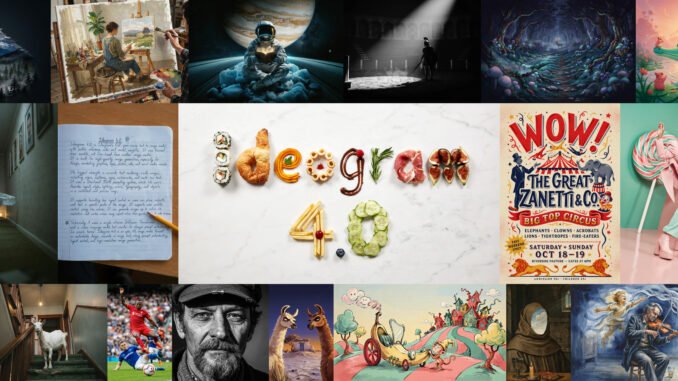
Ideogram has officially released Ideogram 4.0, its first open-weight text-to-image foundation model. The new model brings a strong focus on design workflows, typography, layout control, and high-resolution image generation, positioning itself as a serious competitor to both proprietary AI image generators and other open-source models.
If you’re thinking about purchasing a new GPU, we’d greatly appreciate it if you used our Amazon Associate links. The price you pay will be exactly the same, but Amazon provides us with a small commission for each purchase. It’s a simple way to support our site and helps us keep creating useful content for you. Recommended GPUs: RTX 5090, RTX 5080, and RTX 5070. #ad
Unlike many image models that primarily target photorealistic artwork, Ideogram 4.0 is designed to excel at creating posters, advertisements, social media graphics, branding materials, and other content that requires accurate text rendering and precise object placement.
What Is Ideogram 4.0?
Ideogram 4.0 is a 9.3-billion-parameter image generation model built from scratch using a single-stream Diffusion Transformer (DiT) architecture. The company has released both the model weights and inference code, allowing developers and businesses to run the model locally, fine-tune it, and integrate it into custom workflows.
Key specifications include:
- 9.3B parameter open-weight model
- Native support for resolutions up to 2048 pixels
- Flexible aspect ratios
- FP8 and NF4 quantized checkpoints
- Local deployment support
- Commercial licensing options for enterprise use
One notable advantage is that the NF4 version can run on a single 24 GB GPU, making local deployment more accessible for advanced users.
Built for Design Rather Than Just Art
Most AI image models are optimized for generating illustrations, concept art, or photorealistic scenes. Ideogram 4.0 takes a different approach by focusing heavily on design-related tasks.
The model was trained using structured JSON captions instead of traditional natural language descriptions. These captions can describe:
- Layout structure
- Object placement
- Typography
- Color palettes
- Bounding boxes
- Visual hierarchy
This structured training approach allows Ideogram 4.0 to generate images with significantly more control over composition and text placement than many competing models.
For designers, this means AI-generated posters, advertisements, product mockups, and social graphics can require far less manual editing after generation.
Improved Typography and Text Rendering
Text rendering has long been a weakness of image generation models. Even the best models often struggle with spelling, alignment, and multi-line layouts.
Ideogram claims that version 4.0 achieves a score of 0.97 on the X-Omni English OCR benchmark, demonstrating a high level of text accuracy inside generated images. The company also highlights significant improvements in:
- Poster design
- Multi-line typography
- Marketing graphics
- Logos and branding concepts
- Layout-heavy creative work
This focus on typography is one of the main reasons many designers are paying attention to the release.
Structured JSON Prompting
Perhaps the most interesting feature in Ideogram 4.0 is its structured JSON prompting system.
Instead of relying solely on traditional text prompts, users can define elements such as:
- Background descriptions
- Individual objects
- Text blocks
- Bounding box locations
- Color palettes
- Style settings
The model validates the JSON structure before generation and uses the structured information directly during inference.
This approach allows for significantly more predictable outputs when generating complex layouts, making the model particularly useful for professional design applications.
Native 2K Image Generation
Ideogram 4.0 supports image generation up to 2048 pixels without requiring separate upscaling models.
Supported formats include:
- Square images
- Portrait images
- Landscape images
- Ultrawide banners
- Phone wallpapers
- Social media headers
The model automatically adjusts its sampling strategy based on resolution, allowing a single model checkpoint to handle multiple output formats.
For designers and marketers creating assets across multiple platforms, this flexibility can streamline production workflows.
Community Reaction
The release has generated significant discussion within the AI image generation community.
Many users have praised:
- Text rendering quality
- Layout control
- Prompt adherence
- Open-weight availability
- ComfyUI support
Several community members describe Ideogram 4.0 as one of the strongest open-weight image models currently available, especially for design-oriented tasks. Others note that while it may not fully replace leading proprietary systems in every scenario, it represents a major step forward for local image generation workflows.
The ability to run the model locally while maintaining strong typography and layout performance is a particularly attractive feature for businesses and creators concerned about privacy and data ownership.
Why This Release Matters
The AI image generation landscape has increasingly been dominated by proprietary services. While closed models often lead in quality and capabilities, they also limit customization, local deployment, and fine-tuning.
Ideogram 4.0 offers an alternative by providing:
- Open weights
- Local deployment options
- Fine-tuning capabilities
- Strong text rendering
- Advanced layout control
For designers, developers, marketers, and AI enthusiasts, the release demonstrates that open-weight models continue to close the gap with proprietary systems while offering greater flexibility and control.
Final Thoughts
Ideogram 4.0 is one of the most significant open-weight image model releases of 2026 so far. While many AI image generators focus primarily on photorealism, Ideogram has chosen to prioritize design workflows, typography, and composition control.
The combination of open weights, structured JSON prompting, native 2K output, and strong text rendering makes it a compelling option for anyone creating marketing materials, posters, branding assets, social media graphics, or other design-heavy content.
For users who value local deployment and professional design capabilities, Ideogram 4.0 is a release worth watching closely.
Leave a Reply