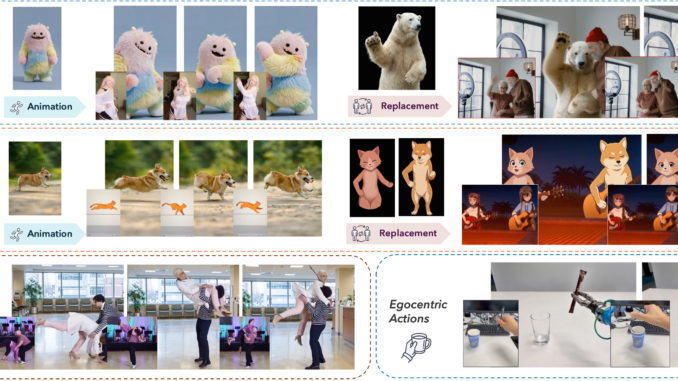
The Z.ai team has officially released SCAIL-2, a new open-source character animation model that could significantly change how creators approach motion transfer, character replacement, and AI-driven animation workflows.
If you’re thinking about purchasing a new GPU, we’d greatly appreciate it if you used our Amazon Associate links. The price you pay will be exactly the same, but Amazon provides us with a small commission for each purchase. It’s a simple way to support our site and helps us keep creating useful content for you. Recommended GPUs: RTX 5090, RTX 5080, and RTX 5070. #ad
Built on top of the Wan ecosystem, SCAIL-2 introduces a major shift from traditional pose-based animation systems by eliminating the need for skeleton extraction and other intermediate representations.
For creators using ComfyUI, Wan 2.2, Flux, Qwen-Image, or AI influencer workflows, SCAIL-2 is one of the most important releases of 2026.
What Is SCAIL-2?
SCAIL-2 is an end-to-end character animation model that transfers motion from a driving video directly to a reference character image.
Unlike traditional animation pipelines, SCAIL-2 does not rely on:
- OpenPose skeletons
- Stick figure representations
- DensePose maps
- Complex inpainting masks
Instead, the model directly consumes the driving video and learns motion transfer through an end-to-end conditioning framework. According to the research paper, this approach preserves motion details that are often lost when converting videos into pose representations.
Why This Matters
Most AI animation workflows today follow a similar pattern:
- Extract a pose skeleton from a driving video
- Convert motion into an intermediate representation
- Generate a new video from the reference image and pose sequence
While effective, this process throws away a significant amount of information.
Depth relationships, object interactions, contact points, camera motion, and subtle body dynamics are often lost during pose extraction.
SCAIL-2 avoids this limitation by feeding the driving video directly into the model, allowing it to learn motion transfer without reducing the input to a simplified skeleton representation.
Key Features
End-to-End Motion Transfer
The headline feature is direct video-driven animation.
Simply provide:
- A reference character image
- A driving video
The model handles motion transfer without requiring pose extraction.
Character Replacement
SCAIL-2 can replace a character in a scene while preserving the original motion and performance.
This opens up possibilities for:
- Virtual influencers
- AI actors
- Character swapping
- Consistent branded avatars
Multi-Character Support
Many animation models struggle when multiple subjects appear in the same scene.
SCAIL-2 was designed with multi-character scenarios in mind and can animate more complex scenes than traditional pose-driven systems.
Animal and Non-Human Motion Transfer
One of the more interesting capabilities demonstrated by the team is support for animal-driven animation.
Because the model is not limited to human skeleton representations, it can handle motion sources that would be difficult or impossible for OpenPose-based pipelines.
Built on Wan Technology
SCAIL-2 uses components from the Wan ecosystem and ships with integrated Wan VAE and T5 components.
The project also benefits from the strong video generation foundation established by Wan 2.2, which introduced:
- Mixture-of-Experts architecture
- Improved motion understanding
- Cinematic aesthetic control
- Better semantic consistency
These improvements helped make Wan one of the strongest open-source video generation platforms available today.
ComfyUI Support Arrived Quickly
Good news for ComfyUI users: SCAIL-2 support is already appearing in the ecosystem.
Community developers have reported that SCAIL-2 has been integrated into recent ComfyUI builds, allowing users to experiment with the model using familiar node-based workflows. Community feedback highlights the flexibility gained from removing skeleton-based control inputs.
For creators already running Wan workflows, getting started with SCAIL-2 should feel relatively familiar.
How Does It Compare to Wan2.2-Animate?
Wan2.2-Animate remains an excellent choice for character animation and expression transfer.
However, SCAIL-2 takes a different approach.
Wan2.2-Animate
- Strong animation quality
- Uses dedicated animation framework
- Excellent facial expression transfer
- Mature workflow support
SCAIL-2
- End-to-end driving
- No skeleton extraction required
- Better support for unusual motion sources
- More flexible multi-character workflows
- Character replacement capabilities
For many creators, SCAIL-2 may become the preferred option when dealing with complex motion or non-standard animation scenarios.
Hardware Requirements
SCAIL-2 currently supports resolutions including:
- 512p
- 704p
The project recommends dimensions divisible by 32 and leverages Wan-based components under the hood. As with most modern video generation models, high-end GPUs will provide the best experience.
Users with RTX 4090 and RTX 5090 GPUs should be particularly well-positioned to experiment with the model.
Final Thoughts
SCAIL-2 represents a major evolution in open-source character animation.
Rather than improving pose extraction, the team eliminated the dependency on pose extraction entirely.
The result is a more flexible animation system capable of handling character replacement, multi-character scenes, animal motion, and complex performances while preserving information that traditional skeleton-based workflows often lose.
For AI creators building virtual influencers, animated characters, AI actors, or cinematic video content, SCAIL-2 is one of the most promising open-source releases of the year.
If the early community results are any indication, SCAIL-2 may become the new benchmark for character animation inside the Wan ecosystem.
Resources
- Model: https://huggingface.co/Comfy-Org/SCAIL-2/tree/main/diffusion_models
- Workflows: Kijai’s test workflow, Infinite length workflow on RunningHub
- Sam 3.1 checkpoint: sam3.1_multiplex_fp16.safetensors
Leave a Reply